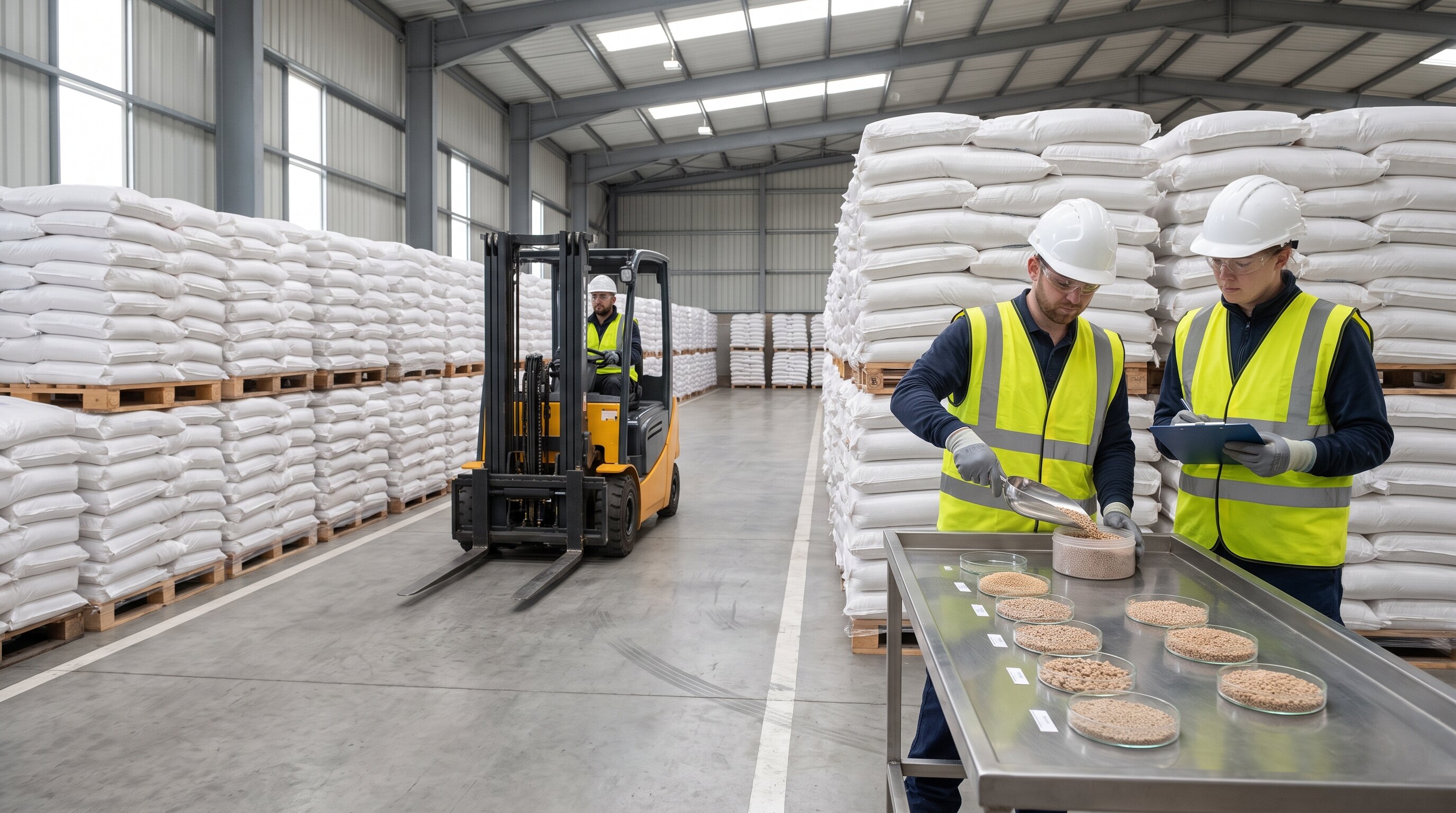
Sarpah/Products/Fertilizers/DAP (NP 18:46)
Product brief

DAP (NP 18:46)

Diammonium phosphate

DAP — Diammonium Phosphate (NP 18:46)

Specification

CharacteristicValue
GradeNP 18:46
Total nitrogen (N)≥ 18%
Available phosphate (P₂O₅)≥ 46%
pH6.0 – 7.2
Granule crush strength≥ 6 MPa (≈ 60 N/granule)
Granulometry≥ 97% in the 1–6 mm fraction
Moisture≤ 1%

Standard: KS 1900-3:2011 / KS EAS 750. Sampling per KS 158:2018.

Origin

Russia, Kazakhstan, Belarus (Belarusian DAP is in scope; the Belarus exclusion is producer-entity-specific to potash (Belaruskali / BPC) — see Sanctions, AML & KYC), Egypt, Morocco.

The Russia–Belarus–Kazakhstan complex produces DAP at scale. Egyptian DAP from Suez and Moroccan DAP from Jorf Lasfar are alternative origins where price-arbitrage favours them; Sarpah's origination spans both the CIS and African phosphate corridors.

Loadports

CorridorPortInspector
Black SeaNovorossiyskSGS
Black Sea (transit)PotiBureau Veritas
Black Sea (transit)ConstantaSGS
BalticUst-LugaSGS / Bureau Veritas
Far EastVladivostokSGS
EgyptSuez (Adabiyah)SGS
MoroccoJorf LasfarBureau Veritas

Volume

10,000–50,000 MT per shipment by sea. 12,500–50,000 MT per month by land.

Delivery Terms

FOB / CFR / CIF Mombasa. ASWP on bilateral agreement.

Payment

Buyer's bank issues; seller's bank advises or — where required — confirms. Sarpah is not on the instrument chain.

MT103 prepayment with APG under URDG 758 for factory-direct flow; irrevocable DLC under UCP 600 for trading-house flow; SBLC under URDG 758 / ISP98 for multi-shipment SPAs. Confirmation by non-designated prime correspondent bank where the SPA requires.

Application

DAP is the dominant planting fertilizer in Kenyan agriculture. Maize, wheat, sugar cane, coffee and horticulture crops receive DAP at planting for the high phosphate content driving root establishment and early growth.

The National Fertilizer Subsidy Programme procures DAP as the lead planting-cycle product. NCPB depot distribution targets the long-rains window (March–May planting in central and western Kenya) and the short-rains window (October–December). The September 2024 NCPB tender included DAP across multiple lots.

For tea, DAP is applied at planting and at field rehabilitation stages where soil P depletion is documented. For coffee, DAP is applied at planting and at periodic top-dressing for mature stands. For sugar cane, DAP is applied at planting in West Kenya (Mumias, Kibos, Kakamega), at Sony Sugar (South Nyanza), and at coastal KISCOL operations.

For Kenya's high-altitude maize zones (Trans Nzoia, Uasin Gishu, Bungoma, Nandi), DAP at 50 kg per acre is the standard planting application. The agronomic argument for DAP over NPK 23:23:0 in these zones is the lower N:P:K ratio dilution and higher P availability; for Kenya's low-rainfall zones (Eastern, parts of Rift Valley), NPK blends may substitute.

Compliance

  • Buyer-side product registration with the Fertilizer & Animal Foodstuffs Board (Cap 345 framework); the buyer is the importer of record
  • KEBS Certificate of Conformity at load port (SGS, Intertek, Bureau Veritas).
  • Certificate of Origin from origin Chamber of Commerce.
  • Certificate of Analysis, Certificate of Weight.
  • EAC CET: HS 3105.30.00 (DAP). Duty 0%. VAT exempt under Finance Act 2025. IDF 2.5%. RDL 2%.

Procurement Profile

Buyer TypeVolume RangeCycle
NCPB / KNTC subsidy programme80,000–150,000 MT per long-rains cycleQ4–Q1, Q2–Q3
FAFB-registered blender10,000–50,000 MT per shipmentRecurring
Sugar estate planting3,000–10,000 MT per planting cycleQ1, Q3
Coffee estate / KPCU cooperative1,500–5,000 MT per quarterPre-flush
Horticulture exporter500–3,000 MT per quarterYear-round
EAC re-export10,000–30,000 MT per shipmentPer Uganda / Rwanda subsidy

Indicative Pricing

Indicative pricing on enquiry — see /buyer-process. For per-cargo quote, send an enquiry.

Talk to us

Specify volume, destination port, payment instrument, target shipment window, and FAFB-registered importer reference.

Talk to us →